AROUND THE HOUSE · ORIGINAL 3D STUDY
What does the correct key actually line up?
Follow five pin pairs to one turning boundary.
Start with the narrated walkthrough.
See the whole mechanism, then inspect it yourself below.
Take it apart and inspect every system.
Click a part to highlight it and read why it matters.
A familiar object. A hidden system.
Follow five pin pairs to one turning boundary.
The key clears a boundary.
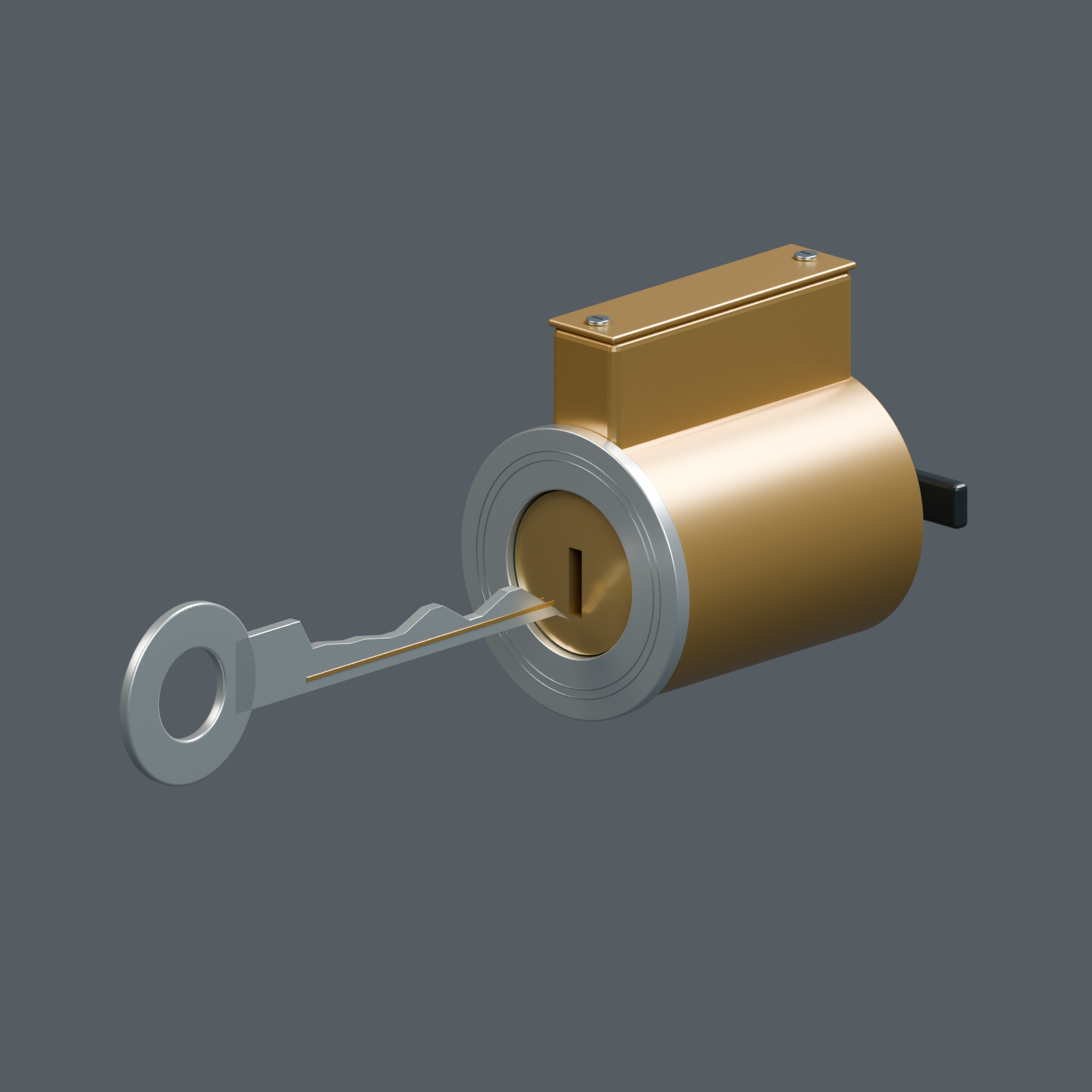
Spring-loaded pairs of pins normally cross the boundary between the fixed shell and the rotating plug. This fictional key lifts the stacks until each split sits at that boundary. Only then does the plug turn.
A matching key aligns the splits between pin pairs. The plug can then turn inside the fixed shell.
Read the explanation
Each stack bridges two pieces.The lower pin rests on the key; the upper pin sits beneath a spring. Without the correct alignment, a pin crosses the plug–shell boundary and prevents ordinary key rotation. The sectioned wall is hidden only to reveal this relationship.
Different cuts produce different lifts.The entering key raises each stack according to its profile. The bottom pins have different lengths. In this deliberately fictional example, the matching key brings their upper ends to the same plug–shell boundary when fully inserted.
Every split must clear the same boundary.The shear line is the boundary between plug and shell—not a separate part. The demonstration pauses with all five pin pairs split at that boundary, before the plug rotates. Alignment must exist simultaneously across the stacks.
The plug turns; the shell does not.The key, lower pins and plug rotate together. The upper pins and springs remain in the fixed housing. The rear actuator follows the plug; a complete door latch is outside this model. The cycle returns upright before the key withdraws.
Sources and safety
- Schlage: A conventional pin-tumbler stack combines a bottom pin, an upper pin and a spring.
- Schlage: Bottom-pin lengths correspond to key-cut depths; the matching key brings the stacks to the required alignment.
- Schlage: Pin alignment clears the plug–shell boundary so that the plug and key can rotate together.
Educational correct-key operation only. This is not locksmith training, a real key code, a repair guide or a security rating. Do not use this fictional model to modify locks or reproduce keys.
Scope and limitations
A generic five-stack pin-tumbler cylinder using one fictional correct key. Master keying, special security pins, complete door hardware, key duplication and bypass methods are outside this lesson.
- Original generic conventional pin-tumbler lock with a deliberately invented nonstandard key; not a real key code, copied product or security claim.
- Correct-key operation only. No picking, decoding, bypass, repair or service sequence.
- The key-contact surface and paired pin splits are analytically matched to the invented geometry.
- All splits align before the plug, key, bottom pins and rear cam rotate. Top pins and springs stay with the fixed housing.
- Initial geometry has the key outside and pins resting. The motion cycle begins at exactly that saved pose and returns to it.
- The rotating barrel wall is omitted in teaching section; the actual front face and rear hub retain the plug referent while exposing the pin action.
- Dimensions, spring compression and clearances are illustrative, not manufacturer specifications or a working security design.
- No text is baked into geometry. The rear door-latch mechanism is outside scope.
- The animated demonstration is slowed and contains a teaching pause at alignment. Dimensions and spring compression are illustrative.
A conventional pin-tumbler stack combines a bottom pin, an upper pin and a spring.Applies to: A generic five-stack pin-tumbler cylinder using one fictional correct key. Master keying, special security pins, complete door hardware, key duplication and bypass methods are outside this lesson. Uncertainty: Other cylinder designs can use different mechanisms or additional elements.
Bottom-pin lengths correspond to key-cut depths; the matching key brings the stacks to the required alignment.Applies to: A generic five-stack pin-tumbler cylinder using one fictional correct key. Master keying, special security pins, complete door hardware, key duplication and bypass methods are outside this lesson. Uncertainty: This model uses a deliberately fictional profile, not a manufacturer key or code.
Pin alignment clears the plug–shell boundary so that the plug and key can rotate together.Applies to: A generic five-stack pin-tumbler cylinder using one fictional correct key. Master keying, special security pins, complete door hardware, key duplication and bypass methods are outside this lesson. Uncertainty: Normal operation is illustrated, not resistance to manipulation, damage or attack.