SPORTS PHYSICS · REVIEWED CUTAWAY
Where does a bat's power really come from: material, flex, or swing?
Material matters, but so do swing speed, balance and collision efficiency.
Start with the narrated walkthrough.
See the whole mechanism, then inspect it yourself below.
Take it apart and inspect every system.
Click a part to highlight it and read why it matters.
LOOK CLOSER
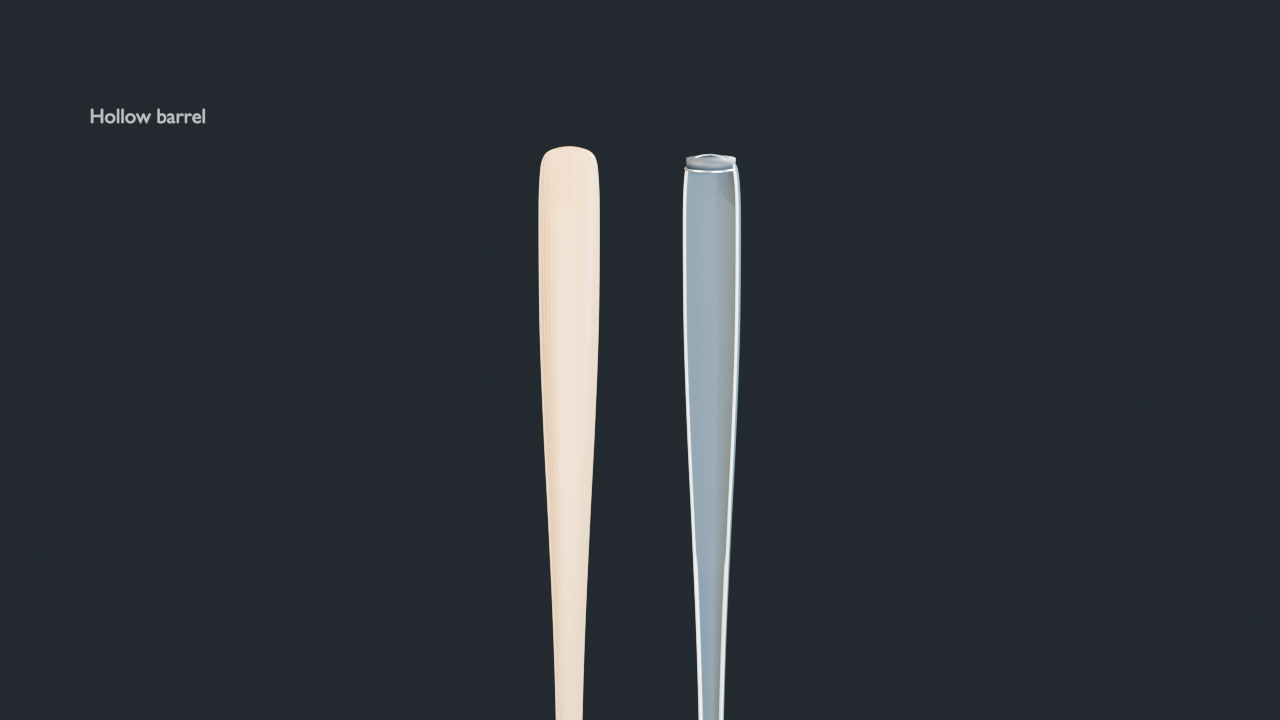
Solid wood barrel
The wood bat is a solid one-piece structure in this comparison. Its collision response does not come from a hollow barrel wall.
A hollow barrel can rebound. No material wins by itself.
Read the explanation
Solid wood barrelThe wood bat is a solid one-piece structure in this comparison. Its collision response does not come from a hollow barrel wall.
Hollow metal barrelA hollow non-wood barrel can flex and return energy through a trampoline effect; its magnitude depends on construction and regulation.
Mass distributionMoment of inertia about the hands affects how a bat swings. Equal total mass does not guarantee equal handling.
Sources and safety
- Nathan, Russell and Smith: A hollow non-wood barrel can deform and return energy through a trampoline effect.
- NCAA: BBCOR rules constrain non-wood collision performance toward wood-like levels in regulated play.
- University of Illinois Physics of Baseball: Bat speed, impact location, effective mass, collision efficiency and moment of inertia all contribute to batted-ball outcome and handling.
Use only bats approved for the relevant league and inspect them for damage. Batting requires appropriate protective equipment, spacing and supervision.
Scope and limitations
A qualitative comparison of solid wood and hollow non-wood baseball bats in regulated play. It does not predict a particular player’s swing or certify a bat.
- The highlighted barrel section is qualitative and does not simulate impact deformation.
- No exit speed, distance, mass distribution or certification is inferred for these generic models.
A hollow non-wood barrel can deform and return energy through a trampoline effect.Applies to: A qualitative comparison of solid wood and hollow non-wood baseball bats in regulated play. It does not predict a particular player’s swing or certify a bat. Uncertainty: The effect varies by construction and does not mean every metal bat outperforms wood.
BBCOR rules constrain non-wood collision performance toward wood-like levels in regulated play.Applies to: A qualitative comparison of solid wood and hollow non-wood baseball bats in regulated play. It does not predict a particular player’s swing or certify a bat. Uncertainty: This generic illustration is not a certification mark or compliance test.
Bat speed, impact location, effective mass, collision efficiency and moment of inertia all contribute to batted-ball outcome and handling.Applies to: A qualitative comparison of solid wood and hollow non-wood baseball bats in regulated play. It does not predict a particular player’s swing or certify a bat. Uncertainty: The lesson is qualitative and does not model an individual swing.