INSIDE THE CAR · ORIGINAL 3D STUDY
How does one brake piston squeeze both sides?
One piston. Two sides of the disc.
Start with the narrated walkthrough.
See the whole mechanism, then inspect it yourself below.
Take it apart and inspect every system.
Click a part to highlight it and read why it matters.
A familiar object. A hidden system.
One piston. Two sides of the disc.
The housing moves too.
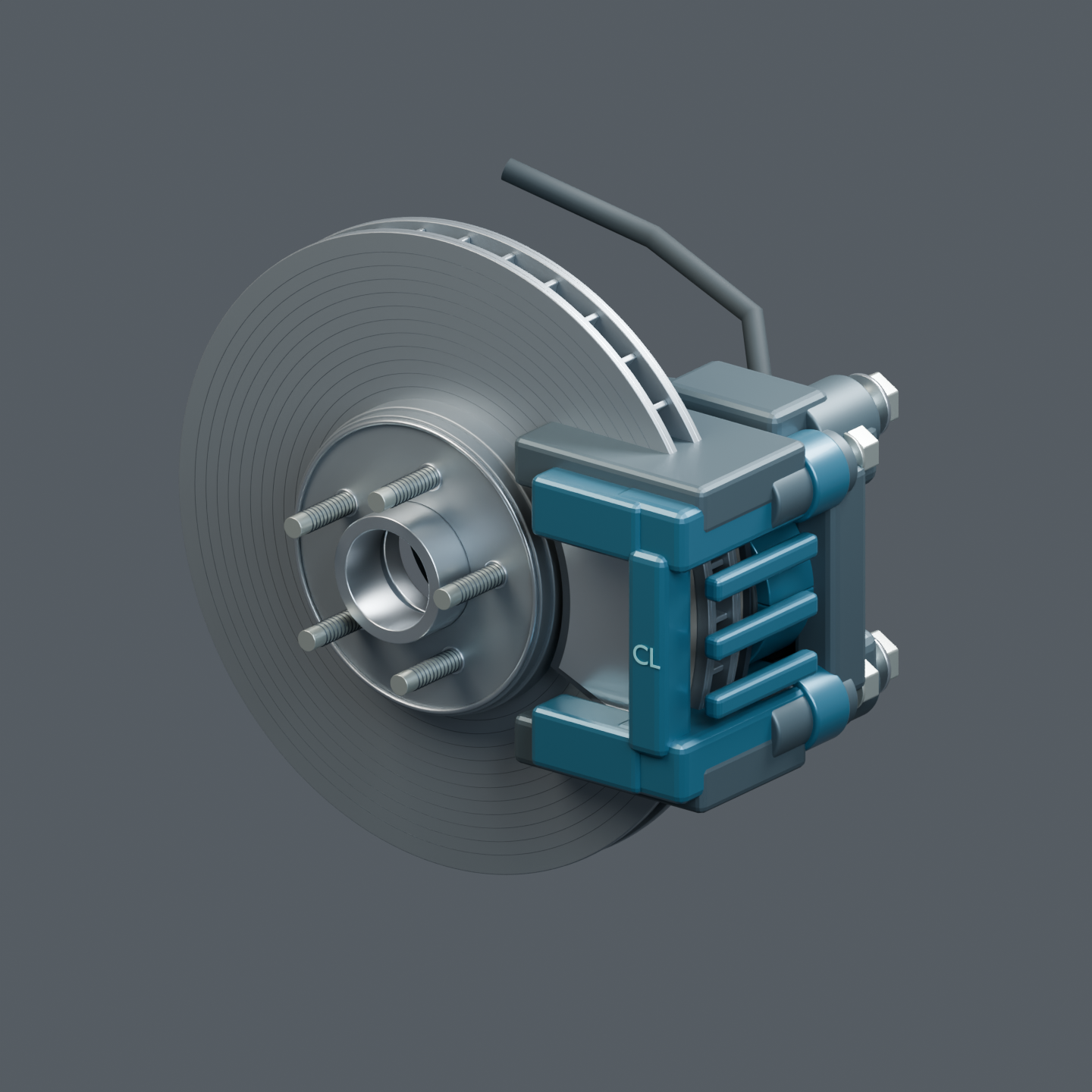
The piston presses one pad. The caliper is free to slide along its guides, bringing the other pad inward. Pull the assembly apart, then return to the section to see which pieces move and which stay fixed.
The piston pushes one side. The sliding caliper brings in the other.
Read the explanation
Pressure acts behind the piston.The brake hose connects a sealed hydraulic chamber to the piston. Pressure pushes the piston toward the inboard pad. This is a contained system—not a continuous stream flowing through the caliper.
Both pads press the flat faces—not the rim.The piston advances toward one face of the disc. Reaction shifts the caliper in the opposite direction, pressing the outboard pad against the other face. The visible clamp cycle is deliberately slow; its small clearances are illustrative.
“Floating” means guided sliding.The fixed carrier holds its position. Parallel guide pins let the caliper body slide along the disc axis. This is how a single piston can load both pads; fixed calipers use a different arrangement.
Braking energy has to go somewhere.When a moving disc is gripped, friction transfers energy into heat. The rotor’s internal passages help it shed heat. This stationary-disc study shows only clamp and release; it does not simulate a moving car, stopping distance or temperature.
Sources and safety
- Brembo: Hydraulic pressure acts on a piston, pressing the inboard pad against the disc.
- Brembo: Reaction moves a floating caliper along its guides so the opposite side also presses a pad against the disc.
- Brembo: Friction at the pads and disc converts motion into heat that the brake assembly must dissipate.
Brakes are safety-critical. This lesson is not a service manual and provides no repair, bleeding, torque, adjustment or road-test instructions. Use the actual vehicle service information and a qualified technician.
Scope and limitations
A generic single-piston floating hydraulic disc brake with a ventilated rotor. The wheel, pedal, master cylinder, ABS, brake booster and whole vehicle are not modeled. Opposed-piston fixed calipers, drum brakes and regenerative braking work differently.
- Original generic single-piston floating caliper, not a manufacturer-specific model.
- Dimensions are plausible educational geometry, not measured service specifications.
- Hydraulic chamber is a closed volume; no continuous flow or pressure value is claimed.
- Pad travel and operating timing are illustrative; no brake service, torque or road-test instructions.
- Exploded view is spatial decomposition; the knuckle and carrier remain fixed during actual operation.
- The rotor stays stationary during this slow clamp-and-release illustration. It is not a braking dynamics or thermal simulation.
- Some casting sections are removed only to make the piston chamber visible. Small internal fittings and hidden connections are simplified.
Hydraulic pressure acts on a piston, pressing the inboard pad against the disc.Applies to: A generic single-piston floating hydraulic disc brake with a ventilated rotor. The wheel, pedal, master cylinder, ABS, brake booster and whole vehicle are not modeled. Opposed-piston fixed calipers, drum brakes and regenerative braking work differently. Uncertainty: Geometry is generic; pressure, dimensions and stopping performance are not predicted.
Reaction moves a floating caliper along its guides so the opposite side also presses a pad against the disc.Applies to: Single-piston floating calipers, not opposed-piston fixed designs. Uncertainty: Operating clearances and travel vary by product. The animation does not teach adjustment.
Friction at the pads and disc converts motion into heat that the brake assembly must dissipate.Applies to: Friction braking systems. Uncertainty: No measured temperature, braking distance, cooling rate or safety performance is asserted.