HOME MACHINE · ORIGINAL 3D STUDY
Why does it not need to fill to the top?
A circulating wash, not a full bathtub.
Start with the narrated walkthrough.
See the whole mechanism, then inspect it yourself below.
Take it apart and inspect every system.
Click a part to highlight it and read why it matters.
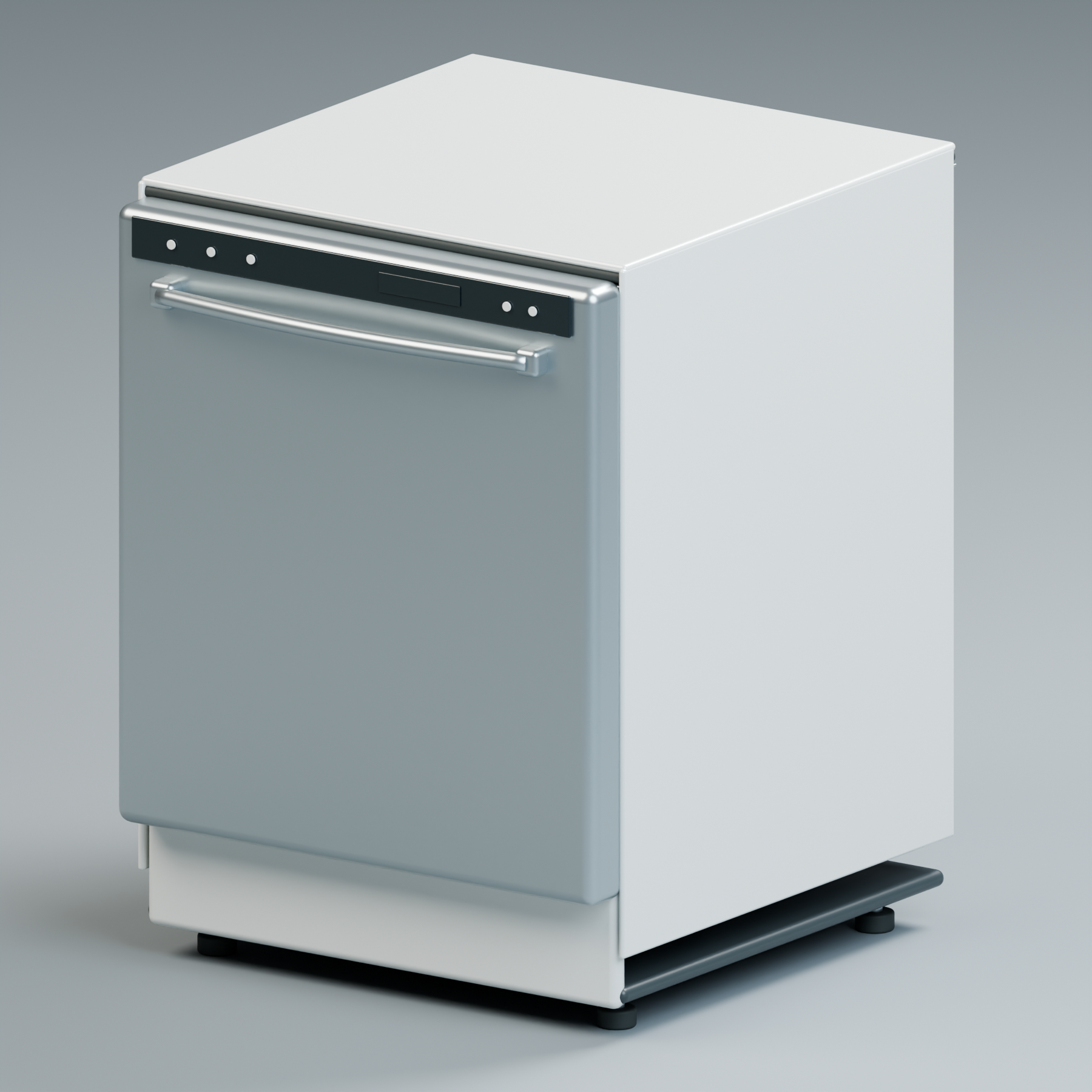
A familiar object. A hidden system.
A circulating wash, not a full bathtub.
A shallow pool can supply dishes on both racks.
Follow the pump and selector as this example supplies its two arms in turns. The same model opens for inspection and reassembles. Alternating arms are one design choice, not a rule for every dishwasher.
Collect, pump, spray and return. Draining is a separate step.
Read the explanation
The water stays low. The wash reaches high.The pump draws from the shallow pool below the racks. The filter intercepts larger debris before it reaches the pump; filtration is not perfect. Removing the water section is a viewing convention, not a draining animation.
One aperture selects a stationary branch.In this illustrative two-zone layout, the disc turns between the lower and upper supply ports. The wash pump pauses during the switch. The timing is slowed and authored for teaching, not a measured appliance cycle.
The supplied arm turns; its partner waits.Pressurised water leaves spray openings and reaches the dishes; water then falls back to the base. Here you can inspect the hollow arms and their alternating motion. External jets and falling water are omitted rather than shown as rigid arrows attached to rotating nozzles.
Reusing water and removing it are different jobs.This layout has a separate drain pump and outlet hose. Their placement is shown for inspection; the sealed pump interior and draining water level are not simulated. The optional wash animation remains a recirculation demonstration, not a drain cycle.
Sources and safety
- GE Appliances: A low working water level can supply spray arms through the wash pump.
- GE Appliances: Some dishwasher systems supply spray arms in turns and pause the wash pump between phases.
- Bosch: Filters intercept larger debris, while food or limescale can still obstruct spray openings.
Electricity, moving parts, hot water and cleaning chemicals can be hazardous. This is an educational illustration, not instructions to open or operate a dishwasher with guards or the door removed. Follow the actual appliance manual; service work belongs to qualified personnel.
Scope and limitations
Original illustrative two-zone recirculating dishwasher with shallow sump, centrifugal wash pump, rotary selector, hollow spray arms and separate sealed drain pump. Not a product replica, measured design, fluid simulation or service guide.
- Original schematic two-zone appliance, not manufacturer CAD or service dimensions. The original standalone disc selector is functionally source-bound, not a patent drawing replica.
- Water remains shallow and is retained through normal recirculation. Fresh fill and drain are distinct controlled states; no full-height flooded chamber.
- Two genuine hollow arms alternate. Tangential drive-nozzle reaction supplies their rotation; a hidden electric motor on each arm is not implied. Timings and slow rotation are illustrative, not a measured wash cycle.
- Continuous cloth/filter microstructure, detergent chemistry, electrical control internals, drying, sanitization and performance are not simulated. No temperature, pressure, RPM or maintenance recommendation.
- Removed cabinet, tube and pump walls are an inspection treatment. All particles must be hidden during explosion; mass flow is shown only in aligned cutaway.
- Markers remain in the stationary supply passages and stop at the pump housing. External spray and gravity-return trajectories are deliberately omitted.
- The cycle times and particle speeds are authored for explanation, not measurements. Both filled and sectioned water surfaces are inspection states, not a drain simulation.
- This clean teaching model does not depict an obstruction. Blockage examples are separate, explicitly illustrative scenarios.
A low working water level can supply spray arms through the wash pump.Applies to: Original illustrative two-zone recirculating dishwasher with shallow sump, centrifugal wash pump, rotary selector, hollow spray arms and separate sealed drain pump. Not a product replica, measured design, fluid simulation or service guide. Uncertainty: No water volume, savings percentage or wash performance is calculated.
Some dishwasher systems supply spray arms in turns and pause the wash pump between phases.Applies to: Original illustrative two-zone recirculating dishwasher with shallow sump, centrifugal wash pump, rotary selector, hollow spray arms and separate sealed drain pump. Not a product replica, measured design, fluid simulation or service guide. Uncertainty: This original two-zone model does not reproduce the source manufacturer’s exact mechanism or cycle timing.
Filters intercept larger debris, while food or limescale can still obstruct spray openings.Applies to: Original illustrative two-zone recirculating dishwasher with shallow sump, centrifugal wash pump, rotary selector, hollow spray arms and separate sealed drain pump. Not a product replica, measured design, fluid simulation or service guide. Uncertainty: This clean teaching model does not simulate blockage severity or prescribe maintenance.