DRYER V2 · PHOTO-STYLE FILM
Dryer V2: Why can a hot dryer leave clothes wet?
New photographic-style film; the interactive model below remains a separate schematic explanation.
← Compare with the original dryerStart with the narrated walkthrough.
See the whole mechanism, then inspect it yourself below.
Take it apart and inspect every system.
Click a part to highlight it and read why it matters.
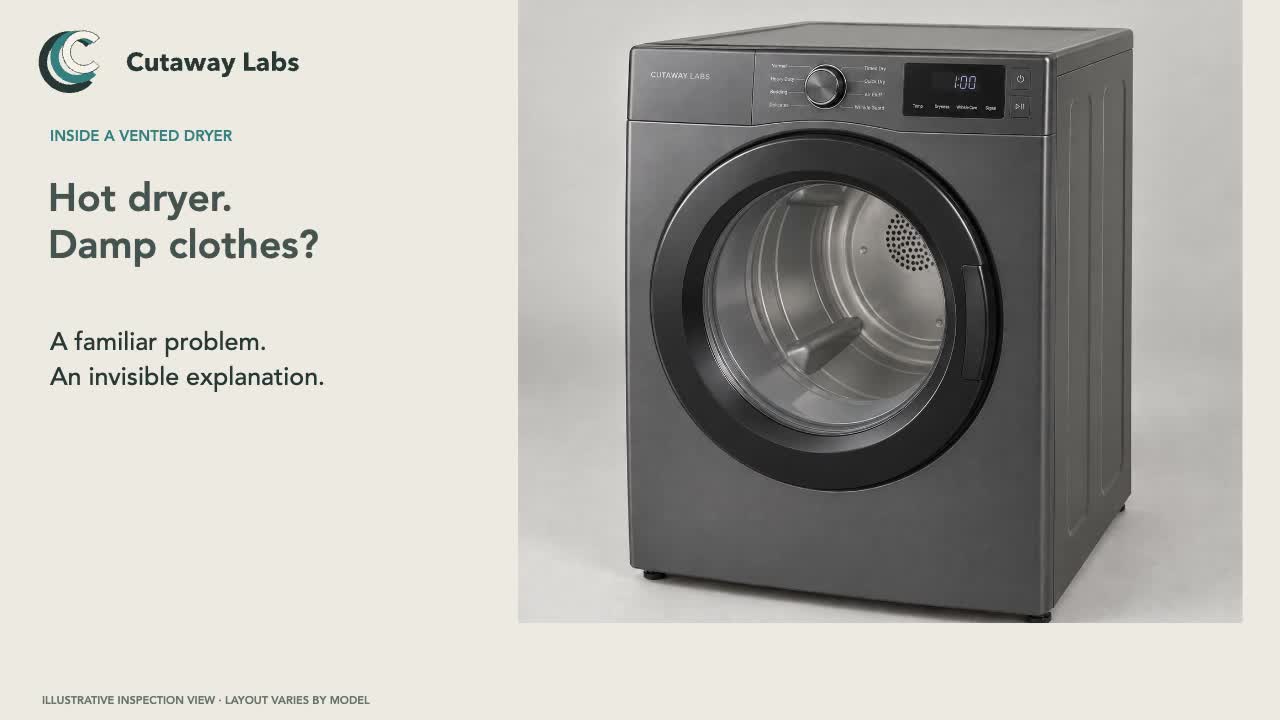
A familiar object. A hidden system.
See where the moisture goes.
Heat starts the journey. Airflow completes it.
This is the original schematic interactive dryer, not a reconstruction of the graphite appliance in the V2 film. Both explain the same heat-and-airflow principle; their appearance and layout differ.
Heat releases moisture. Airflow carries it away.
Transcript
0–9.07925sYour dryer is hot. The drum is turning. So why are the clothes still damp? The missing ingredient may be moving air.
9.07925–18.740166666666667sIn a vented electric dryer, a heater warms the incoming air. That energy helps liquid water in the fabric evaporate.
18.740166666666667–28.79958333333333sTumbling exposes fabric to moving air. Overloading restricts air circulation. Clothes that enter soaking wet also take longer to dry.
28.79958333333333–40.053666666666665sBut evaporation is only half the job. A blower carries moist air through the exhaust duct, which must vent outdoors, not into an enclosed space.
40.053666666666665–48.38370833333333sOn its way out, air passes through a lint screen. The mesh catches loose fibres, but it needs space for air to pass.
48.38370833333333–56.64508333333333sLint buildup or a crushed exhaust duct can restrict that flow. The heater may still work, while the load takes longer to dry.
56.64508333333333–67.34845833333334sTo keep air moving, clean the lint screen before each load and leave room to tumble. Follow your manual. For difficult vent cleaning, use a qualified professional.
67.34845833333334–78.49475000000001sThis explanation is for a vented dryer. Heat-pump dryers handle moisture differently. Persistent trouble needs proper diagnosis, not repeated hotter cycles.
78.49475000000001–87.56908333333335sThe next time a dryer feels hot but leaves clothes damp, remember: drying needs both heat and a clear path for moving air.
87.56908333333335–88.72870833333334sThis
88.72870833333334–92.26666666666667sis Cutaway Labs.
Sources and safety
- U.S. Department of Energy: A vented dryer warms incoming air and moves it through the tumbling load.
- Whirlpool: Heat enables evaporation, while airflow carries moisture-laden air through the lint and exhaust path.
- Whirlpool: A dirty lint screen or crushed vent hose can contribute to longer dry times or damp loads.
- Whirlpool: Residue can coat a lint screen and lengthen drying time even when the screen does not look full.
- U.S. Fire Administration: Keeping the lint filter and venting system clear is a fire-safety concern as well as a drying-performance concern.
Observation only. Disconnect power before moving an appliance. Do not open energized electrical or gas sections. Stop and contact a qualified professional for burning or gas odors, scorching, or inaccessible ductwork.
Scope and limitations
A generic vented electric dryer. The film uses a photographic-style door-removed inspection view and separate explanatory schematics. The interactive assembly is a different illustrative dryer, not a product replica or service guide.
- Component sizes, spacing, and duct routing are adjusted for legibility.
- Air and humidity are shown as qualitative pulses, not a physics simulation.
- The original 24-group model includes illustrative controls, drive belt, supports, fasteners and wiring, but is not dimensionally validated against an OEM dryer.
- The household vent hose and exterior building flap are not modeled. Flow beyond the rear outlet indicates onward exhaust, not a rendered building connection.
- Laundry lift and release, particle speeds and the amber outlet obstruction are illustrative, not physical simulations or measured performance.
- The shell cutaway is an authored teaching view, not a service procedure.
- The graphite film appliance and schematic interactive assembly differ in appearance and internal layout. They illustrate the same principle, not one identical physical product.
The displayed assembly is a generic conceptual teaching model rather than an OEM service diagram.Applies to: The shipped prototype only. Uncertainty: Not intended to reproduce dimensions or construction of a particular dryer.
A vented dryer warms incoming air and moves it through the tumbling load.Applies to: Generic vented clothes dryers; exact heater and inlet layout varies. Uncertainty: The visualization is qualitative.
Heat enables evaporation, while airflow carries moisture-laden air through the lint and exhaust path.Applies to: Generic causal explanation; not remote diagnosis. Uncertainty: Drying performance also depends on load size, incoming moisture, controls, and appliance condition.
A dirty lint screen or crushed vent hose can contribute to longer dry times or damp loads.Applies to: Possible causes only; does not identify a fault in a specific appliance. Uncertainty: Other causes can produce the same symptom.
Residue can coat a lint screen and lengthen drying time even when the screen does not look full.Applies to: Lint screens compatible with the manufacturer's cleaning guidance. Uncertainty: Follow the instructions for the specific appliance.
Keeping the lint filter and venting system clear is a fire-safety concern as well as a drying-performance concern.Applies to: General home dryer safety. Uncertainty: Follow appliance and local fire-safety guidance.