AROUND THE HOUSE · ORIGINAL 3D STUDY
Why does the dust stay when the air escapes?
The air turns. The dust takes a different path.
Start with the narrated walkthrough.
See the whole mechanism, then inspect it yourself below.
Take it apart and inspect every system.
Click a part to highlight it and read why it matters.
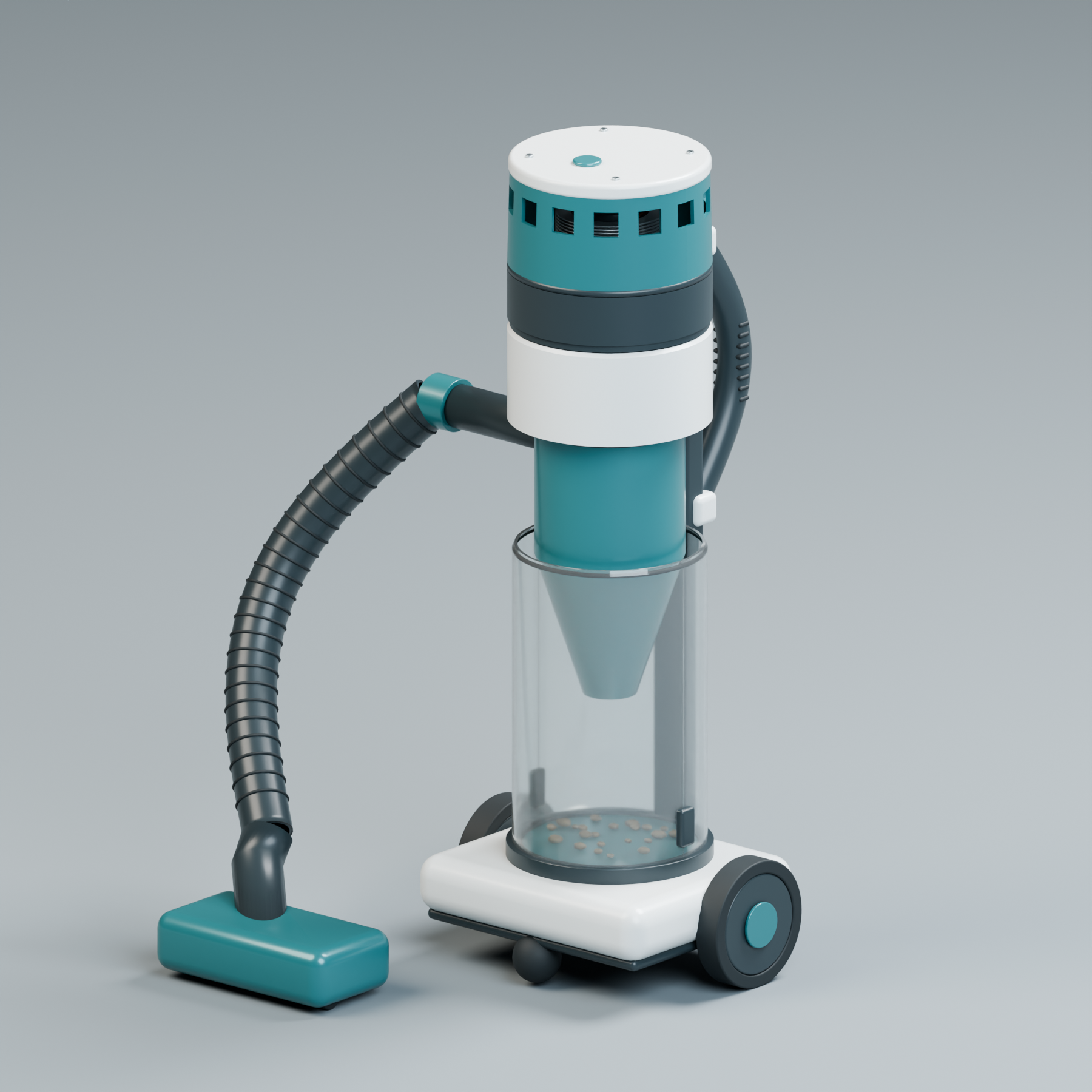
A familiar object. A hidden system.
The air turns. The dust takes a different path.
The cone is stationary; the air is not.
A fan draws air through a stationary cyclone. Larger debris separates into the cup, while air returns up the centre toward a pleated filter. Explore one generic architecture, not a replica or performance-tested product.
The cyclone separates larger debris. A downstream filter catches more.
Read the explanation
A sideways entrance starts the spiral.The inlet enters beside the wall. The downward outer spiral and upward central return have different routes. Blue and green markers are selected teaching paths, not a measurement of individual air molecules.
The collection cup is not the air outlet.Larger particles move toward the wall and drop into the collection cup. Air reverses inside the lower cone and leaves through the central outlet. The gold markers illustrate selected debris; not every particle behaves identically.
Fine particles still need a filter.In this example, air from the central outlet crosses pleated filter media before reaching the fan. The pleats provide more material area in a compact space. Seals matter; this illustration carries no HEPA, efficiency or health claim.
The fan does the moving, not the cone.The electric motor turns an impeller; the cyclone stays still. Markers stop before the rotating blades because no all-angle particle-clearance simulation is claimed. Inspect the surrounding gallery and outlet slots to see where the air leaves.
Sources and safety
- US Environmental Protection Agency: A stationary cyclone can separate particles from a spiralling air stream without rotating the cone.
- US Environmental Protection Agency: In this reverse-flow arrangement, air turns upward through the centre while collected dust leaves below.
- Dyson: Downstream filter media and intact seals have a separate role from cyclone separation.
Educational illustration only. Do not dismantle, bypass filters or seals, run exposed parts, or collect hazardous debris. Follow the actual appliance instructions; this is not repair or maintenance guidance.
Scope and limitations
Original single reverse-flow cyclone with one downstream pre-motor filter. Not a proprietary multi-cyclone array, numerical flow simulation or performance-tested appliance.
- Entirely original procedural geometry and materials; no external models, images or textures.
- Generic single reverse-flow cyclone architecture with one downstream pre-motor filter, not a proprietary multi-cyclone array.
- Cutaway hides physical front wall sections. Air and particle paths must be hidden during explosion; collected debris is hidden in explosion.
- Fan rotation is deliberately slowed. Airflow and particle markers are qualitative; no CFD, measured capture, health, safety or maintenance claim.
- Filter pores are represented by a porous material; real pleats and sealed end interfaces remain physical geometry.
- The marker routes were sampled against the exported mesh at one fan pose; that is not continuous swept-volume certification. Markers stop before the rotating impeller. Fine dust, filter pores, capture efficiency and pressure are not simulated.
A stationary cyclone can separate particles from a spiralling air stream without rotating the cone.Applies to: Original single reverse-flow cyclone with one downstream pre-motor filter. Not a proprietary multi-cyclone array, numerical flow simulation or performance-tested appliance. Uncertainty: Particle size and the actual design affect separation; no efficiency number is inferred.
In this reverse-flow arrangement, air turns upward through the centre while collected dust leaves below.Applies to: Original single reverse-flow cyclone with one downstream pre-motor filter. Not a proprietary multi-cyclone array, numerical flow simulation or performance-tested appliance. Uncertainty: Illustrative centrelines are not a measured velocity field or an exact path for every particle.
Downstream filter media and intact seals have a separate role from cyclone separation.Applies to: Original single reverse-flow cyclone with one downstream pre-motor filter. Not a proprietary multi-cyclone array, numerical flow simulation or performance-tested appliance. Uncertainty: The single pre-motor filter shown is one architecture, not every vacuum design or a HEPA certification.