MUSIC & SOUND · REVIEWED CUTAWAY
How do a trumpet's valves reroute airflow and change pitch?
Valves choose a tube length; the player chooses a resonance.
Start with the narrated walkthrough.
See the whole mechanism, then inspect it yourself below.
Take it apart and inspect every system.
Click a part to highlight it and read why it matters.
LOOK CLOSER
Piston ports
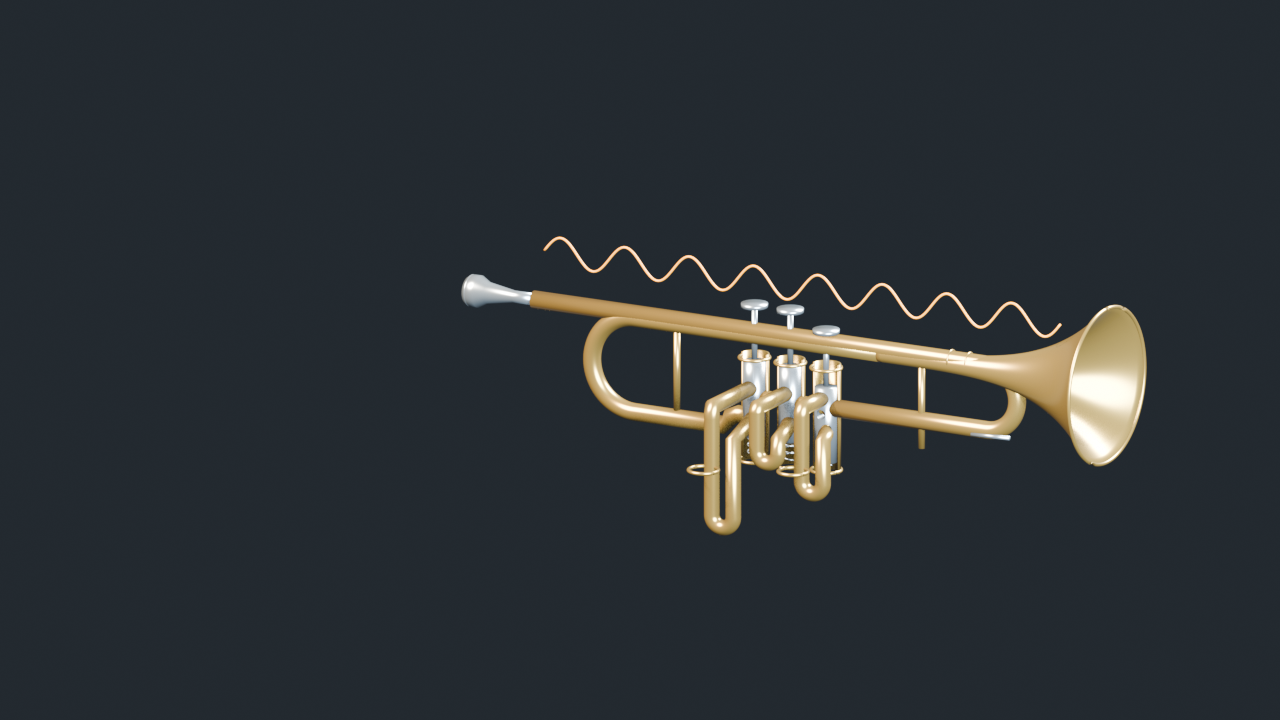
Each piston connects the main bore either to a direct route or to an added loop when the valve is pressed.
Valves add tube length. Lips select the resonance.
Read the explanation
Piston portsEach piston connects the main bore either to a direct route or to an added loop when the valve is pressed.
Added tube loopsSending the air column through extra tubing increases its effective length and lowers its available resonances.
Resonant air columnThe player’s buzzing lips excite the air column and help select one resonance from the harmonic series; air speed alone does not set the note.
Sources and safety
- Yamaha Corporation: Piston valves reroute the air column through supplementary tubing, increasing effective length and lowering resonant frequencies.
- UNSW Music Acoustics: A valve setting selects a harmonic series; the player still selects which resonance sounds with the lips and air-column coupling.
Educational instrument anatomy only. Do not force, disassemble or lubricate an instrument without following its maker’s care instructions.
Scope and limitations
A generic three-piston trumpet. The lesson explains tube routing and resonance qualitatively; it is not a dimensionally calibrated instrument or an acoustic simulation.
- The pressure-wave line is a teaching symbol, not a numerical acoustic simulation.
- Exact valve-loop lengths and intonation adjustments vary by instrument.
Piston valves reroute the air column through supplementary tubing, increasing effective length and lowering resonant frequencies.Applies to: A generic three-piston trumpet. The lesson explains tube routing and resonance qualitatively; it is not a dimensionally calibrated instrument or an acoustic simulation. Uncertainty: Exact added lengths and port geometry vary by trumpet.
A valve setting selects a harmonic series; the player still selects which resonance sounds with the lips and air-column coupling.Applies to: A generic three-piston trumpet. The lesson explains tube routing and resonance qualitatively; it is not a dimensionally calibrated instrument or an acoustic simulation. Uncertainty: This lesson does not calculate impedance, frequency or intonation error.