IN THE CAR · ORIGINAL 3D STUDY
What stops a car from bouncing after a bump?
The oil controls the motion. The gas makes room.
Start with the narrated walkthrough.
See the whole mechanism, then inspect it yourself below.
Take it apart and inspect every system.
Click a part to highlight it and read why it matters.
A familiar object. A hidden system.
The oil controls the motion. The gas makes room.
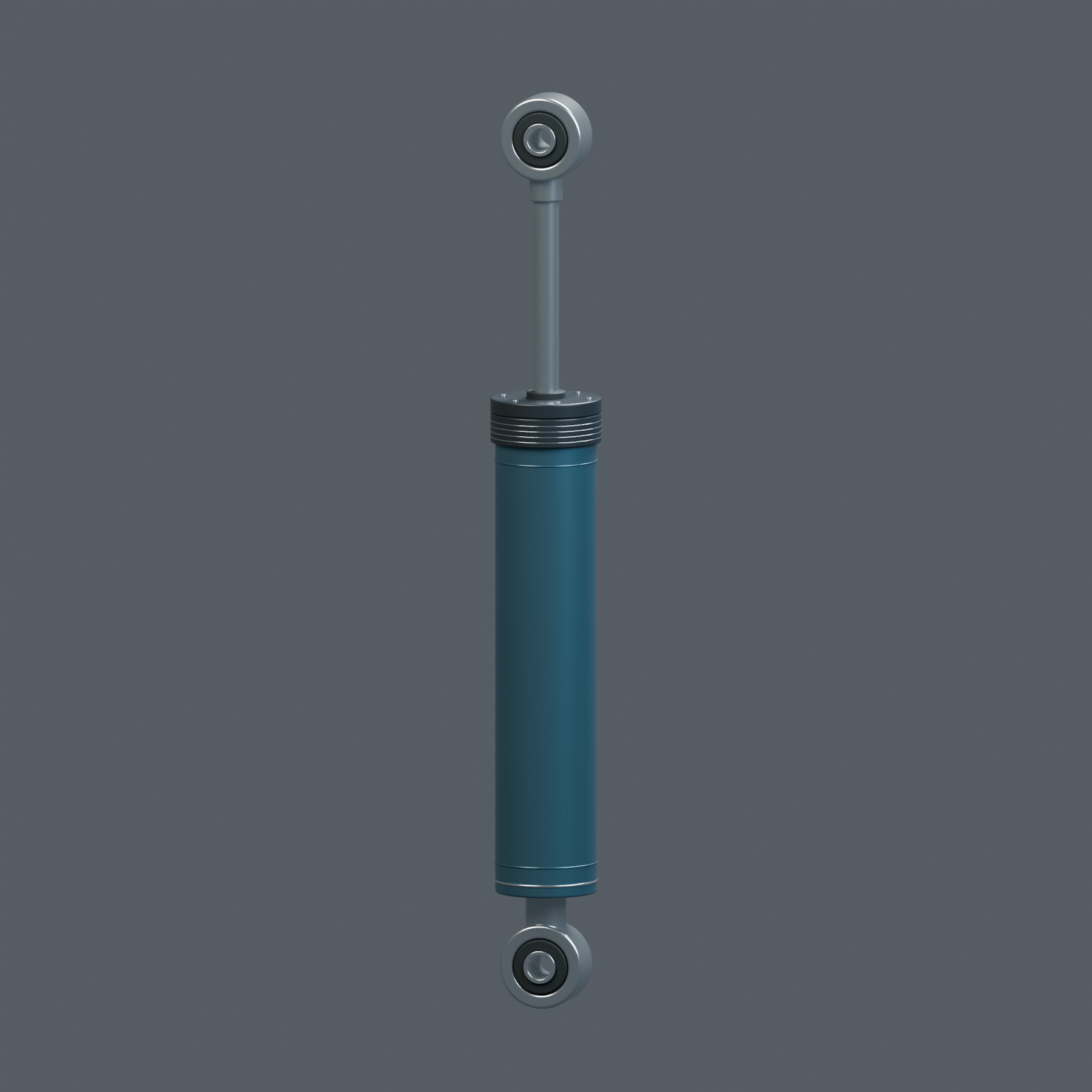
A damper does a different job from a spring.
A moving piston pushes oil through restrictive valves. A second, floating piston keeps the gas separate and makes room for the entering rod. This original monotube illustration is the damper alone; no spring or complete vehicle suspension is shown.
Controlled oil flow resists movement. Separated gas makes room for the rod.
Read the explanation
Oil has to pass through the piston.As the rod enters, the working piston moves through oil. Its compression valves restrict the flow and resist movement. The gold markers follow one selected passage only while its valve leaves are fully open; they move with the actual piston.
The return stroke has its own valve route.On rebound, oil moves through a different set of piston passages. The blue markers appear only in the open-valve portion of the return stroke. These are flexing leaves, not washers that detach. Their shape and motion illustrate the principle, not a real product’s valve tune.
The entering rod takes up space.The floating separator shifts as the rod enters, compressing the gas below it. The oil and gas remain on opposite sides of the sealed piston. This model relates separator travel to the rod and bore areas; it does not calculate pressure or damping force.
A moving rod still needs a sealed boundary.The guide supports the moving rod while the seal closes the opening around it. Gas pressure has a different job: it helps suppress bubble formation in the oil. This cutaway is for understanding the mechanism, not dismantling or servicing a pressurised damper.
Sources and safety
- BILSTEIN Academy: Oil passing through the working piston’s valve pack produces damping during compression and rebound.
- BILSTEIN Academy: A floating separator allows the gas chamber to accommodate the volume of the entering piston rod.
- BILSTEIN Academy: Gas pressure helps suppress cavitation in the oil while the separator keeps the chambers apart.
Pressurised components and vehicle suspension are hazardous. Do not open, heat, puncture, modify or service a damper using this illustration. This is not a repair guide, fitment recommendation or roadworthiness test.
Scope and limitations
An original generic rod-up monotube damper. One oil-filled pressure tube, a valved working piston and a floating gas separator; no twin-tube reservoir, base valve, coil spring or complete suspension.
- Original rod-up monotube engineering illustration, not a manufacturer replica or service drawing.
- All physical parts conserved across assembled, exploded and cutaway states. Fluids are labelled teaching volumes and hidden exploded.
- Working piston stroke .038m is an authored illustration. Separator travel follows rod-area/bore-area volume displacement; these are model units, not product measurements.
- No pressure, damping-force curve, road test, maintenance or compatibility advice. No coil spring is included; this is the damper alone.
- Source references verify architecture, not authored dimensions, materials, hydraulic tuning or performance.
- The six-second motion and valve deflection are illustrative. Marker paths appear only while the valve is visibly open; they are not CFD or a measured oil-flow field.
- Oil and gas volumes become translucent for inspection and disappear in explosion. Neither action means fluid drains away or gas mixes into the oil.
Oil passing through the working piston’s valve pack produces damping during compression and rebound.Applies to: An original generic rod-up monotube damper. One oil-filled pressure tube, a valved working piston and a floating gas separator; no twin-tube reservoir, base valve, coil spring or complete suspension. Uncertainty: The leaf geometry, ports and slowed motion are an original teaching model, not a manufacturer-specific tune.
A floating separator allows the gas chamber to accommodate the volume of the entering piston rod.Applies to: An original generic rod-up monotube damper. One oil-filled pressure tube, a valved working piston and a floating gas separator; no twin-tube reservoir, base valve, coil spring or complete suspension. Uncertainty: The illustrated dimensions establish model volume relationships only; no real-product pressure or travel is implied.
Gas pressure helps suppress cavitation in the oil while the separator keeps the chambers apart.Applies to: An original generic rod-up monotube damper. One oil-filled pressure tube, a valved working piston and a floating gas separator; no twin-tube reservoir, base valve, coil spring or complete suspension. Uncertainty: No pressure, temperature, bubble threshold or force curve is simulated.