AROUND THE HOUSE · ORIGINAL 3D STUDY
What tells a kettle to click off?
Follow the tiny mechanism behind the click.
Start with the narrated walkthrough.
See the whole mechanism, then inspect it yourself below.
Take it apart and inspect every system.
Click a part to highlight it and read why it matters.
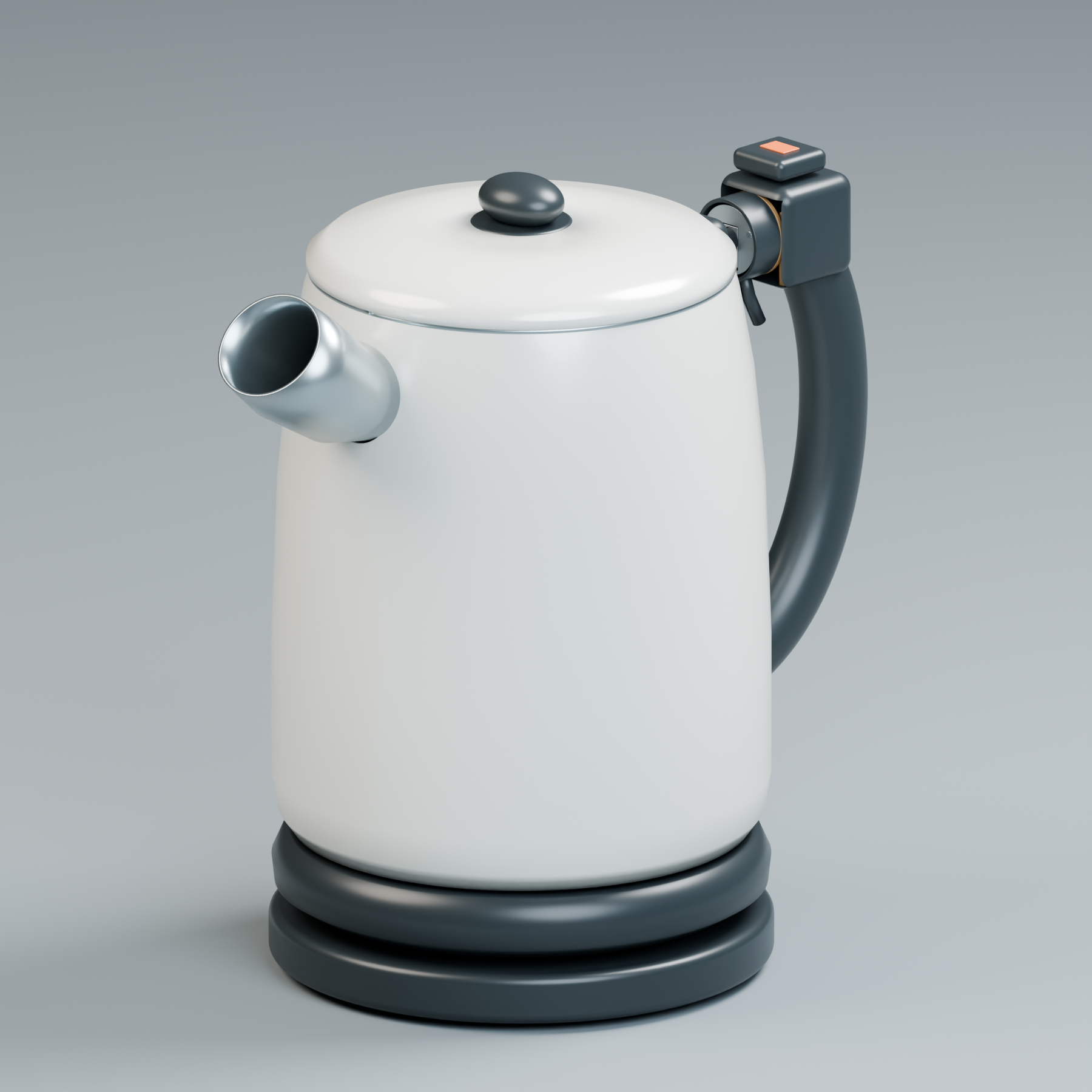
A familiar object. A hidden system.
Follow the tiny mechanism behind the click.
Steam triggers the shutoff.
This mechanical example uses steam to move a sensor, which opens the heater contacts through a sealed link. The drawing is an original teaching model, not a particular kettle or a repair guide.
Steam triggers the normal shutoff. Abnormal overheating has separate protection.
Read the explanation
A small passage leads to the sensor.Follow the blue direction markers from the vessel to the wet sensor chamber. They stop before the dry electrical compartment. These are explanatory markers, not a heat or fluid simulation.
A tiny movement opens a real gap.The bimetal moves the sealed rod. The lever then separates the contacts. Watch the small gap, not just the outer switch. Motion is deliberately slowed; the return is an illustrative reset, not automatic restart.
Motion crosses the divider; steam does not.A flexible seal surrounds the moving rod between the wet and dry spaces. The cutaway removes teaching sections, not working protection. Never open or operate an exposed kettle.
Normal shutoff is not the whole safety system.The separate lower module represents protection against abnormal heater conditions. Its internal design is deliberately not invented here. This is distinct from the normal steam-operated switch; neither should be bypassed or tested by intentionally running a kettle dry.
Sources and safety
- Kettle Solutions, patent EP1312290B1: A steam-heated bimetal can drive a sealed actuator and open dry electrical contacts.
- Strix: Normal steam sensing and abnormal dry-heat sensing are distinct control functions.
- Strix: Control suitability depends on heating-element compatibility and whole-appliance evaluation.
Informational cutaway only. Do not dismantle, bypass, rewire or operate exposed controls, deliberately boil dry, or use this model for appliance repair. Follow the actual product instructions.
Scope and limitations
An original upper-handle mechanical steam-control example. Electronic temperature controls, exact product geometry, operating temperatures, wiring and certification are outside scope.
- Original generic upper-handle mechanical steam-control illustration, not a brand model, exact patent drawing, tested appliance or conformity claim.
- Architecture selected from the text of Kettle Solutions EP1312290B1: wet-side disc, sealed pushrod and dry-side snap switch. No base-mounted steam-controller variant is mixed into this model.
- The upper steam passage, wet chamber, flexible rod seal and separate dry contact space are conserved across all views.
- Normal steam shutoff and separate abnormal-heat protection are distinct. The latter is intentionally a sealed generic module with no invented proprietary internals.
- Travel and controller clearances are illustrative. The slow mechanism cycle is a teaching demonstration, not heat transfer, calibrated snap physics or an auto-restart claim; its return is an illustrative reset.
- Water tint is a viewing aid; the water volume is omitted from the exploded view. No text is baked into geometry.
- No service instructions, live-operation experiment, intentional dry boil, bypass sequence, wiring specification or electrical rating is given.
- Blue markers show a teaching direction only. The cycle repeats for inspection and includes an illustrative reset; it does not imply a kettle automatically restarts.
A steam-heated bimetal can drive a sealed actuator and open dry electrical contacts.Applies to: An original upper-handle mechanical steam-control example. Electronic temperature controls, exact product geometry, operating temperatures, wiring and certification are outside scope. Uncertainty: Many other kettle designs exist; the clearances and timing here are illustrative.
Normal steam sensing and abnormal dry-heat sensing are distinct control functions.Applies to: An original upper-handle mechanical steam-control example. Electronic temperature controls, exact product geometry, operating temperatures, wiring and certification are outside scope. Uncertainty: The lower protection module is schematic, not a claim about every product.
Control suitability depends on heating-element compatibility and whole-appliance evaluation.Applies to: An original upper-handle mechanical steam-control example. Electronic temperature controls, exact product geometry, operating temperatures, wiring and certification are outside scope. Uncertainty: A visually plausible model is not a tested appliance or a parts-substitution guide.