AROUND THE HOUSE · ORIGINAL 3D STUDY
Why does the detector normally miss the light?
A particle gives the light a new direction.
Start with the narrated walkthrough.
See the whole mechanism, then inspect it yourself below.
Take it apart and inspect every system.
Click a part to highlight it and read why it matters.
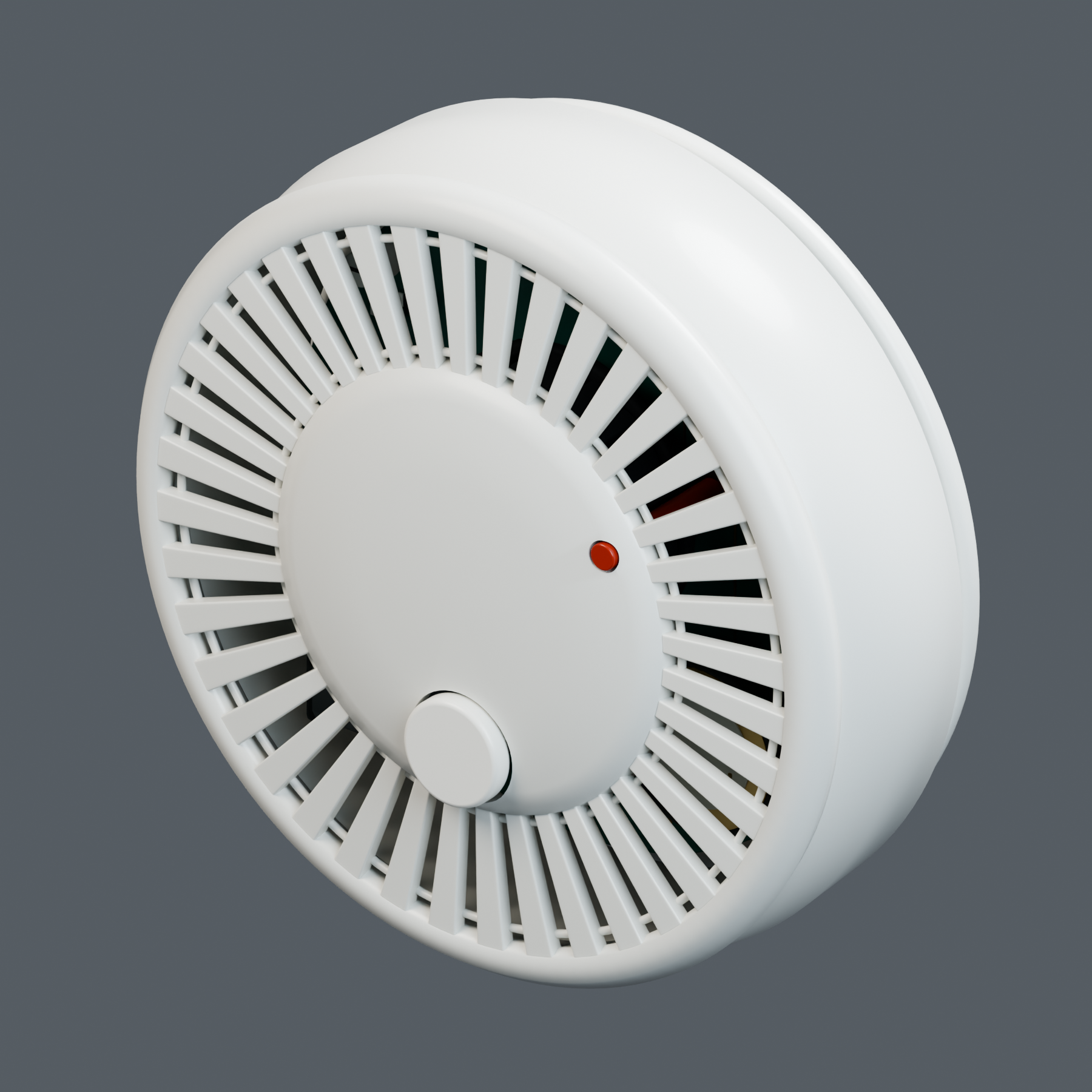
A familiar object. A hidden system.
A particle gives the light a new direction.
The receiver sits outside the main beam.
In this optical example, an emitter shines across a dark chamber. The receiver looks in from another direction. Add illustrative smoke to see a new route appear between them.
Particles redirect some of the light. The receiver detects that changed signal.
Read the explanation
The beam does not point at the receiver.Amber markers cross the chamber from the emitter. The receiver is off to the side. Very little of the original beam reaches it in clear air. The visible amber path represents infrared light that you would not ordinarily see.
Let smoke in; keep stray light down.The offset vanes admit particles while limiting outside light. The cover and chamber lid are hidden only for this lesson. This diagram is not an instruction to open or alter an alarm.
Scattering creates a new route.Add illustrative smoke. A pale particle is held at the beam intersection so you can see the teal branch originate on it and travel toward the receiver. The particles are enlarged and the paths are schematic—not measured smoke, a real detection threshold or a second beam emitted by the receiver.
Received light becomes an electrical signal.Electronics evaluate the receiver signal and can activate the separate sounder. Different particles scatter differently; a drawing cannot predict response time or safety performance. No alarm sound or live-fire experiment is used here.
Sources and safety
- National Institute of Standards and Technology: In this scattered-light arrangement, the direct emitter beam normally misses the receiver.
- National Institute of Standards and Technology: Particles can scatter light toward the receiver; sufficient received signal can trigger the alarm.
- Texas Instruments: A conventional optical chamber limits unwanted light while admitting smoke into the sensing zone.
Educational illustration only. Never disable, open or modify an alarm or make smoke to test this explanation. Follow the actual manufacturer instructions and relevant local guidance. This is not installation advice or a performance claim.
Scope and limitations
An original single-emitter, off-axis scattered-light photoelectric alarm. Ionization, beam-obscuration, carbon-monoxide sensing, calibration, installation and repair are outside scope.
- Original generic single-LED off-axis photoelectric smoke-alarm illustration. No copied CAD, board layout, product model, logo, calibrated optical design or conformity claim.
- An enclosed dark chamber admits smoke while limiting ambient light. The direct emitter beam crosses the sensing volume but does not point into the receiver.
- With smoke present, some light scatters towards the photodiode; electronics interpret the signal and can command the separate sounder. The photodiode is not an emitter.
- Infrared beam and enlarged particles, when displayed, are explicitly schematic overlays, not naked-eye visibility, true particle dimensions, measured scattering or smoke simulation.
- The actual cover and optical lid are removed only for the teaching section. Demonstrate optical sensing only after reassembly into that coherent cutaway, never across an explosion.
- No radioactive ionization chamber, CO sensor, heat-only sensing claim, live fire experiment, alarm-disable instructions or service sequence is included.
- Battery, circuit packages and traces are generic context, not an electrical schematic or safety specification. No text is baked into the model.
- One enlarged particle is held at the scattering intersection for teaching. Amber and teal paths are visible annotations, not visible infrared or a calibrated optical simulation. No warning sound is played.
In this scattered-light arrangement, the direct emitter beam normally misses the receiver.Applies to: An original single-emitter, off-axis scattered-light photoelectric alarm. Ionization, beam-obscuration, carbon-monoxide sensing, calibration, installation and repair are outside scope. Uncertainty: This is a simplified clear-air state, not a guarantee of absolutely zero background light.
Particles can scatter light toward the receiver; sufficient received signal can trigger the alarm.Applies to: An original single-emitter, off-axis scattered-light photoelectric alarm. Ionization, beam-obscuration, carbon-monoxide sensing, calibration, installation and repair are outside scope. Uncertainty: Response depends on particle properties and detector design; no threshold or timing is inferred.
A conventional optical chamber limits unwanted light while admitting smoke into the sensing zone.Applies to: An original single-emitter, off-axis scattered-light photoelectric alarm. Ionization, beam-obscuration, carbon-monoxide sensing, calibration, installation and repair are outside scope. Uncertainty: Newer designs may use different chamber and electronic-rejection strategies.