AROUND THE HOUSE · ORIGINAL 3D STUDY
How does your toilet know when to stop filling?
How does the tank know when to stop filling?
Start with the narrated walkthrough.
See the whole mechanism, then inspect it yourself below.
Take it apart and inspect every system.
Click a part to highlight it and read why it matters.
A familiar object. A hidden system.
How does the tank know when to stop filling?
One valve lets water out. Another knows when to stop letting it in.
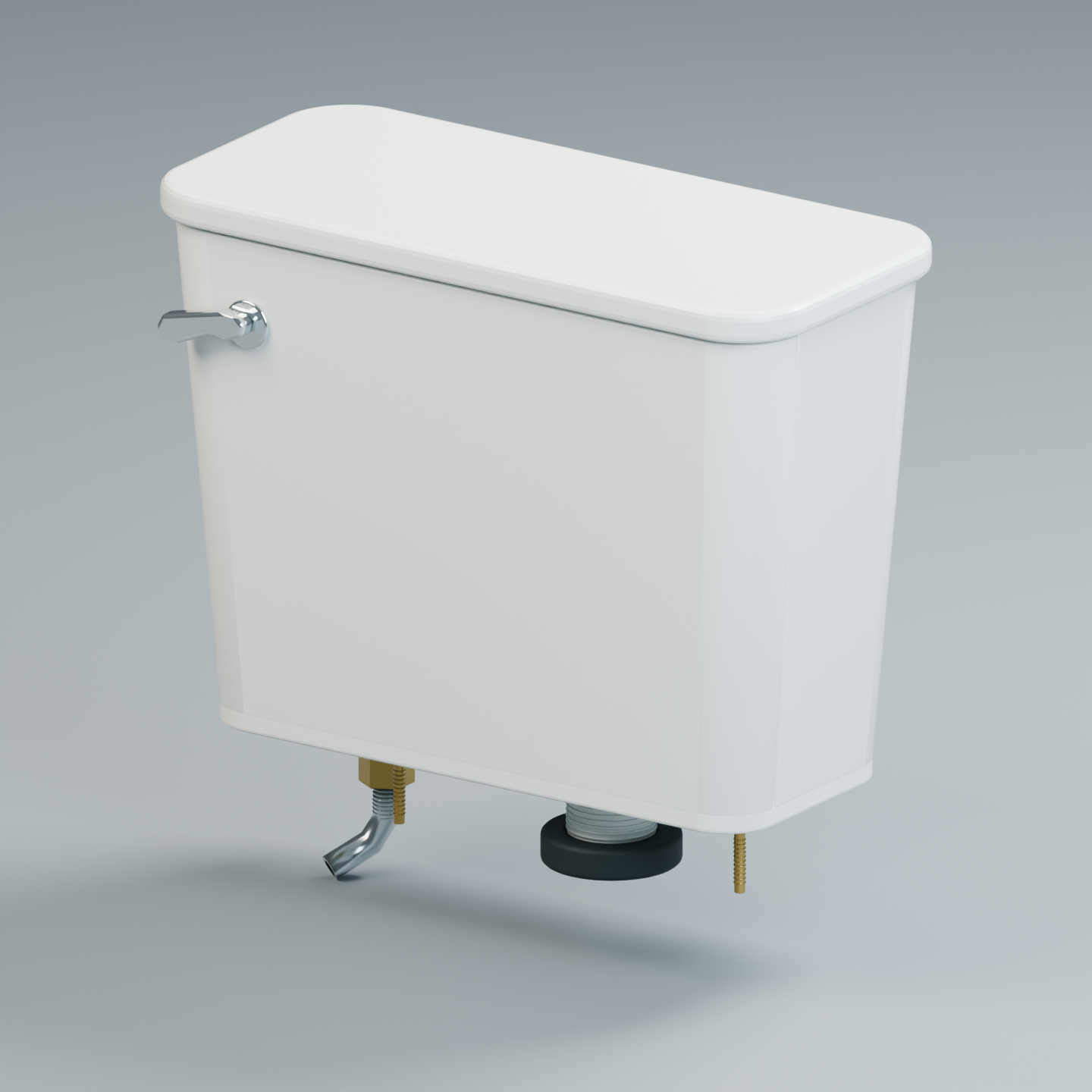
Open the tank and follow a flush. The handle lifts a seal, the stored water falls, and a floating cup helps control the refill. This model shows a gravity tank with a flapper—not every kind of toilet.
The flapper releases stored water. The float tells the inlet when to stop.
Read the explanation
The flapper holds a tankful ready.A closed rubber flapper seals the large flush outlet. The normal water level sits below the overflow rim. The tank releases its stored water toward the bowl below, which is omitted here.
The handle starts it. Gravity does the emptying.The handle moves a lever and chain, lifting the hinged flapper. Water can then leave through the large flush opening. The overflow is a separate route; it is not the normal way the tank empties.
Falling water asks for a refill.As the water level drops, the float cup descends and the fill valve admits supply water. Filling can begin while water is still leaving. The tube above the overflow also sends some refill water toward the bowl.
The rising float closes the inlet.After the flapper reseats, water accumulates and lifts the float. Its linkage closes the fill valve at the set level. The overflow does not switch a faulty inlet off. The motion is slowed and simplified; it is not a plumbing repair demonstration.
Sources and safety
- Fluidmaster: The fill valve admits water and the flush valve releases stored tank water.
- Fluidmaster: A handle lever and chain lift the flapper; a seated flapper needs slack rather than a chain holding it open.
- Fluidmaster: A refill tube sends some fill water toward the bowl through an above-rim connection at the overflow.
Educational explanation, not installation or repair guidance. Do not dismantle plumbing from this illustration; ceramic can crack and water can damage property. Follow the actual product instructions or consult a qualified plumber.
Scope and limitations
A generic gravity cistern with a hinged flapper and float-cup fill valve. The toilet bowl, trap, supply shutoff and building plumbing are outside this model. Siphon, canister, dual-flush and pressure-assisted toilets differ.
- Original generic gravity cistern with hinged flapper and conventional float-cup fill valve, not siphon, dual flush, pressure-assisted or delayed fill.
- Tank only: bowl, trap, drain, building supply and mounting support are omitted. Not an installation, repair or service diagram.
- Real ceramic inner/outer wall surfaces and openings; front wall is an educational section, not a removable service panel.
- Water volume, movement, chain paths and 12-second cycle are illustrative, not measured flow rates or a fluid/dynamics simulation.
- Full illustrative water level lies below overflow opening; refill tube end lies above it; CL mark is above overflow. No universal installation clearances claimed.
- Refill is shown overlapping tank discharge. The float closes the inlet when the level recovers; overflow does not shut off a faulty fill valve.
- All parts retain the exact same original mesh across assembled, cutaway and exploded states. No external models, textures or copied manufacturer geometry.
- Water surfaces and moving dots are illustrative, not a fluid simulation. Chain motion is a guided approximation. Clearances and timing are not service specifications.
- The front ceramic section is removed only for teaching; it is not a removable panel on a real tank.
The fill valve admits water and the flush valve releases stored tank water.Applies to: A generic gravity cistern with a hinged flapper and float-cup fill valve. The toilet bowl, trap, supply shutoff and building plumbing are outside this model. Siphon, canister, dual-flush and pressure-assisted toilets differ. Uncertainty: Different toilet designs use different valve arrangements; this is one common gravity-tank variant.
A handle lever and chain lift the flapper; a seated flapper needs slack rather than a chain holding it open.Applies to: Handle-operated hinged-flapper gravity tanks. Uncertainty: The exact chain length, adjustment and fittings are product-specific and are not taught here.
A refill tube sends some fill water toward the bowl through an above-rim connection at the overflow.Applies to: The float-cup fill-valve arrangement illustrated in this lesson. Uncertainty: Not a claim about all toilet designs or local plumbing requirements.