AROUND THE HOUSE · ORIGINAL 3D STUDY
Why does your drain need to keep some water?
Why is there a bend under the sink?
Start with the narrated walkthrough.
See the whole mechanism, then inspect it yourself below.
Take it apart and inspect every system.
Click a part to highlight it and read why it matters.
A familiar object. A hidden system.
Why is there a bend under the sink?
The drain needs to leave something behind.
A little water stays in the low bend after drainage. That connected water seal blocks the open air route from the drainage pipe to the room. Open the section to see why an empty sink need not mean an empty trap.
Drainage can leave a little water behind. That retained water closes the air route.
Read the explanation
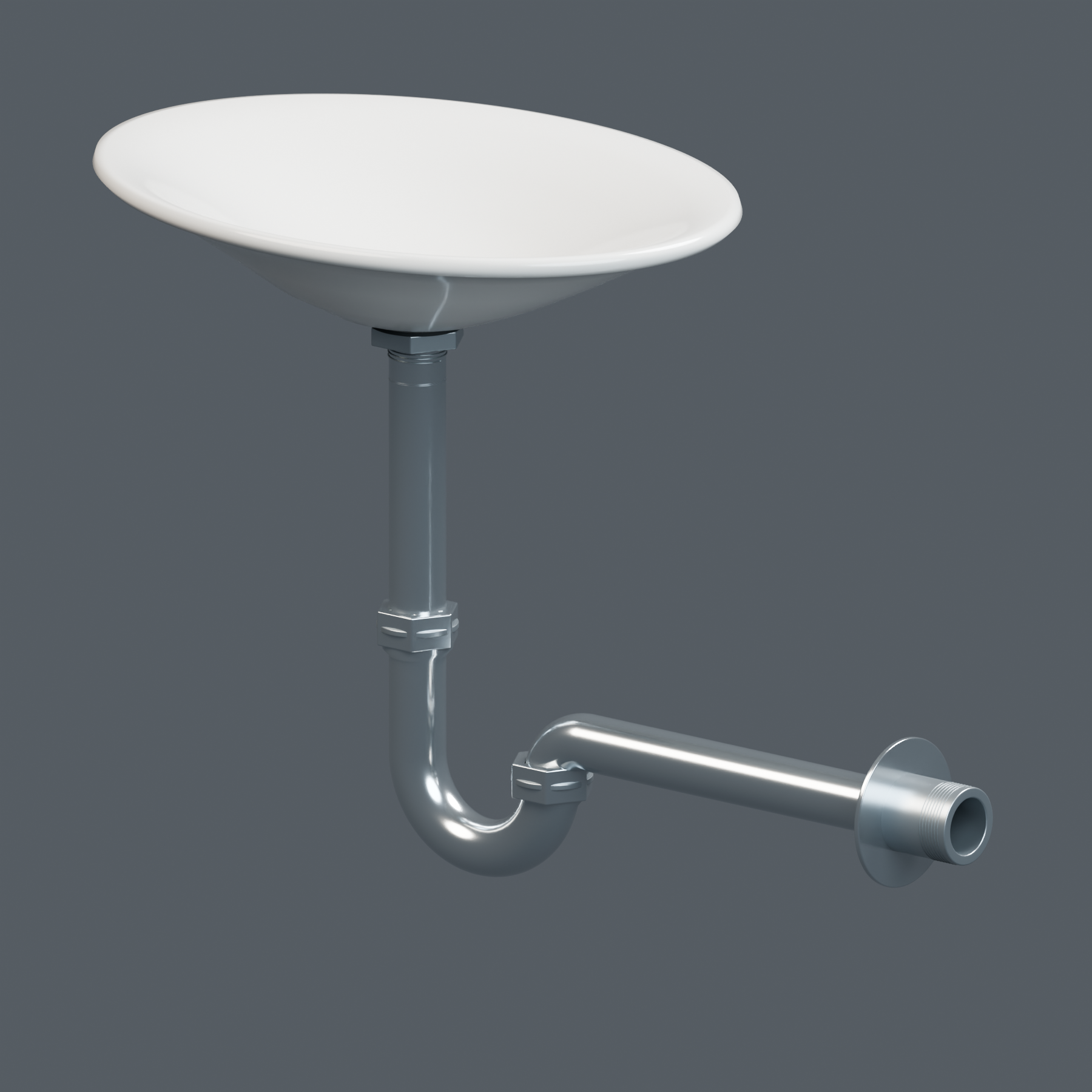
Water has one connected route through the bend.The hollow tailpiece, J-bend and wall arm connect the basin to the downstream drain. Water enters from above, follows the low curve, then leaves along the outlet arm. The blue moving markers show direction, not measured liquid motion.
The lowest water does not simply run away.Once drainage subsides, a connected water volume remains below the outlet weir. It closes the otherwise open air passage around the bend. The level shown is illustrative, not an installation dimension.
New drainage replaces water while leaving a seal.Using the sink sends new water through the trap. The trap is not a permanent stopper: water can pass through while a retained seal remains when the flow stops. Pause the direction trace to inspect the unchanged retained volume.
No water seal means no water barrier.Infrequently used traps can lose water through evaporation. A missing seal can let drain gases pass toward the room. This view does not simulate drying time, leaks, siphoning or building ventilation, and is not a diagnosis of an odour.
Sources and safety
- Oatey: Water remaining in the low trap bend forms a barrier against drain gases reaching the room.
- Oatey: Each use sends new wastewater through the trap, replacing water in the curve while a seal remains after normal drainage.
- Oatey: An infrequently used P-trap may dry out and lose its water seal.
Educational illustration, not installation, cleaning or repair guidance. Do not dismantle plumbing from this model; real fittings, chemicals, wastewater and leaks need appropriate precautions and product-specific advice. Persistent odours require proper investigation.
Scope and limitations
A generic slip-joint lavatory P-trap with a retained water seal. Building venting, pressure transients, other trap designs and plumbing-code dimensions are outside the model.
- Original generic lavatory P-trap, not a scan, installation plan or plumbing-code dimensional reference.
- True hollow tailpiece, curved bend and arm form one connected lumen; section faces have actual wall thickness.
- Retained water is a clipped, connected illustrative volume below one horizontal waterline; colour is a teaching convention, not wastewater chemistry.
- Normal drainage replaces water but leaves a seal. No gas tracer crosses an intact water seal.
- Fluid geometry is hidden during spatial separation: water is not a detachable component.
- Selected inlet/outlet nuts and washers are hidden in the local teaching section to expose the connected water seal; their assembled positions do not move.
- Downstream venting, pressure transients and evaporation rate prediction are outside scope.
- Flow markers show a teaching route, not a fluid simulation. The retained volume is static; drying, siphoning and leakage are discussed but not animated. The front pipe wall is an educational section, not a removable service panel.
Water remaining in the low trap bend forms a barrier against drain gases reaching the room.Applies to: A generic slip-joint lavatory P-trap with a retained water seal. Building venting, pressure transients, other trap designs and plumbing-code dimensions are outside the model. Uncertainty: The water barrier is not a guarantee against every odour source or every abnormal pressure condition.
Each use sends new wastewater through the trap, replacing water in the curve while a seal remains after normal drainage.Applies to: A generic slip-joint lavatory P-trap with a retained water seal. Building venting, pressure transients, other trap designs and plumbing-code dimensions are outside the model. Uncertainty: Flow volume, mixing and seal dimensions are not measured here.
An infrequently used P-trap may dry out and lose its water seal.Applies to: A generic slip-joint lavatory P-trap with a retained water seal. Building venting, pressure transients, other trap designs and plumbing-code dimensions are outside the model. Uncertainty: Evaporation is only one possible reason for a missing seal; this is not a diagnosis or a universal maintenance schedule.